
Today in Phillippians 3: 4-11, we see Paul talk about what really matters:
4even though I, too, have reason for confidence in the flesh. If anyone else has reason to be confident in the flesh, I have more: 5circumcised on the eighth day, a member of the people of Israel, of the tribe of Benjamin, a Hebrew born of Hebrews; as to the law, a Pharisee; 6as to zeal, a persecutor of the church; as to righteousness under the law, blameless.7 Yet whatever gains I had, these I have come to regard as loss because of Christ. 8More than that, I regard everything as loss because of the surpassing value of knowing Christ Jesus my Lord. For his sake I have suffered the loss of all things, and I regard them as rubbish, in order that I may gain Christ 9and be found in him, not having a righteousness of my own that comes from the law, but one that comes through faith in Christ, the righteousness from God based on faith. 10I want to know Christ and the power of his resurrection and the sharing of his sufferings by becoming like him in his death, 11if somehow I may attain the resurrection from the dead.
 Paul in this part of Phillippians is talking about how he (and we) have to trust more in the grace of Jesus than we should in our own works. He is talking to a group of Christians that are tempted to rely more upon their works and the law than they are on Jesus.
So, Paul lists off all the stuff that he has done. Stuff, that if you could earn your salvation by what you have done, would surely earn him a place in eternity. Look at what he has done. He was as righteous in the law. He had done all the “right” things. Paul was about as holy as one could be by the law.
And look at what he says – he considers that all rubbish when compared to knowing Jesus. He has found in Jesus a righteousness that he could have never found through the law. He discovered a salvation that doesn’t come from one’s works but comes only through the gift of God’s grace.
He wants to know Jesus. To know His life. His death. And His resurrection.
Paul found this. He found what really matters wasn’t what he had done. What really mattered was what Jesus had done. When compared to the goodness of God, the grace of God, the power of God, the life of God, the stuff of earth just can’t compare.
Paul learned grace. And here’s what’s cool about grace, especially in the world we live in. In this world of pressure and work and stress and results and performance reviews. Grace is not about you. It’s about Him. And we can rest in grace.
Rest. In grace.
Rest. In Jesus.
Rest. In His power.
You are loved. Not because of anything you’ve ever done. But because of all that He has done. Paul considered everything rubbish compared to knowing Jesus. He wasn’t saying that was bad. He was saying that Jesus was better.
Paul found what really matters.
If you’d like to receive these thoughts by email, be sure to click here and join my email devotional group!
 We talked Monday about why Chapter 16 is made it like it is, with the notations of the different manuscripts. Today, we see these last few verses in Mark are in four different sections, and only one of them really makes us go, huh?
 One of the things that we see when the women encounter the resurrection is fear. They are afraid. We see it illustrated in other Gospels, they think the body has been stolen or something awful has happened.
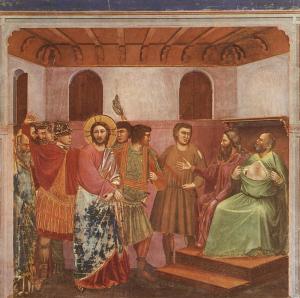 One of the things that you always take away from going to the Holy Land is the reality of all that Jesus went through for our sake. You see the places where He was abused, where He was mocked, where He was spit upon.
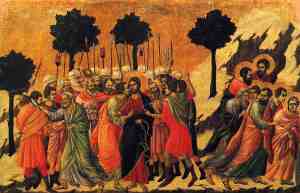 Today, we see Jesus betrayed, and we see much what we talked about yesterday. They came for Him with swords and clubs. One of the disciples reacted with anger (John
 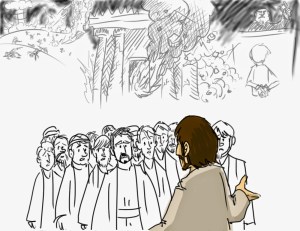 This is one of the apocalyptic parts of Mark’s Gospel. Some of what is happening in this passage is referring to the destruction fo the Temple in 70 AD while other parts of the text are talking about the second coming. Which parts are which? That’s a great question. . . .
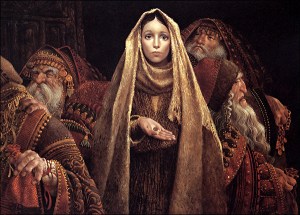 This is seen to be true in the last story, 40-44, where the religious leader makes an offering and demands attention for the gift that he is given. That is contrasted with the widow is give out of her poverty, but gives all that she is has.
 The Prince of Peace is born! That’s what we say. That’s what we believe. Let me repeat that

 RevAndy.org