Day Ten with Mark: Mark 3:13-19

Today in our journey through Mark, we look at Mark 3:13-19, where Jesus appoints His twelve disciples:

13 He went up the mountain and called to him those whom he wanted, and they came to him. 14 And he appointed twelve, whom he also named apostles, to be with him, and to be sent out to proclaim the message, 15 and to have authority to cast out demons. 16 So he appointed the twelve: Simon (to whom he gave the name Peter); 17 James son of Zebedee and John the brother of James (to whom he gave the name Boanerges, that is, Sons of Thunder); 18 and Andrew, and Philip, and Bartholomew, and Matthew, and Thomas, and James son of Alphaeus, and Thaddaeus, and Simon the Cananaean, 19 and Judas Iscariot, who betrayed him.
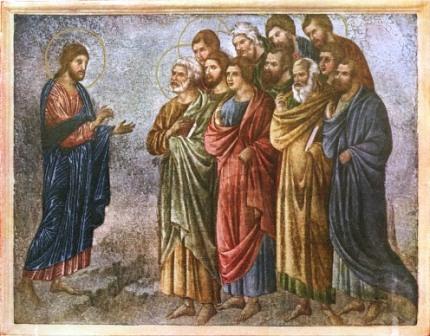
sending_twelveA couple of things that we notice in this passage.  First, some clarifications of language.  Here it says that He appointed “Twelve.”  They aren’t given a title.  Before the Resurrection, these twelve are called Disciples and after they are called Apostles.  Same people, though. The definition of an Apostle is one that Jesus appeared to and gave a specific task. That’s why Paul is an Apostle, even through he was not one of the Disciples.

Another thing is that there are different “levels,” if you will, of people who follow Jesus. There are the general crowds that follow Him when He preaches, but those crowds go back to their homes when the day is over.  Then there are the women that followed and supported His ministry, like Mary Magdalene.  And in this culture this is extraordinary.  Women didn’t leave the home, much less follow an itinerant preacher around Galilee.  But Jesus included them in His followers and it was Mary that was the first tell anyone that He had risen from the dead.

Then you have the 72 that Jesus sent out to do ministry as well.  This would have been those that were close to Him, that were faithful and that followed Him.   He had a large group with Him at almost all times.

But we see in this, the Twelve. There is great symbology about the number twelve, remember there were twelve tribes of Israel, in appointing twelve, Jesus is showing that His ministry stands fully in line with the Old Testament and that all the promises of the Old Testament were ultimately pointing to Him.

Notice, though who He calls.  Not many were educated.  They were fishermen.  They were common.  In fact, we don’t know a lot about many of them.  But let me tell you my favorite thing about the Twelve.  There is Simon the Cananaean.  And there is Matthew (or Levi) who we saw Jesus call earlier.  Matthew as a tax collector.  Simon was a member of a group known as the Zealots.  The zealots were a group of Jews that wanted to drive out the Romans. They HATED the Romans. They would often carry a dagger in their belt so that they could kill a Roman when the chance came.

And you know they only people they hated more than Romans?  Tax collectors.  Why?  Because tax collectors where traitors. They betrayed their people to work for the Romans.  Man on man, did they hate tax collectors.

And who were two of the Twelve?  Matthew, a tax collector.  And Simon, a zealot.  Through Jesus they could move past their hatred, their distrust, all the baggage that they brought to this group.

Through Jesus they could.  Through following Him, through making Him their Lord, they could.

If they focus on their “stuff” they would have killed each other.  If they focus on Jesus, they have unity.  When Jesus is in the middle, He brings life out of our diversity and difference. When we put our “stuff” in the middle, it tears us apart.

Jesus was able to bring unity out of such great difference.  And He can do the same today.

May we find our unity and purpose, today and each day, in Jesus Christ.

What questions do you have?  How does this strike you?  Shoot me an email, comment below, or connect with me through social media.

Tomorrow we’ll look at Mark 3:20-30.

If you’d like to receive these thoughts by email, be sure to click here and join my email devotional group!

Day Nine with Mark: Mark 3:7-11

Today in our daily readings with Mark, we look at Mark 3:7-11, entitled A Multitude at the Seaside and Jesus Appoints the Twelve:

A Multitude at the Seaside
7 Jesus departed with his disciples to the sea, and a great multitude from Galilee followed him; 8 hearing all that he was doing, they came to him in great numbers from Judea, Jerusalem, Idumea, beyond the Jordan, and the region around Tyre and Sidon. 9 He told his disciples to have a boat ready for him because of the crowd, so that they would not crush him; 10 for he had cured many, so that all who had diseases pressed upon him to touch him. 11 Whenever the unclean spirits saw him, they fell down before him and shouted, “You are the Son of God!”

slide-10-jesus-on-boatIn these this passage, we people drawn to Jesus.  And you know who they were?  Everyone?  All types of people were drawn to Jesus.  We see in the first section we see where people came to Jesus from.  Everywhere.  Judea, Jerusalem, across the Jordan, everywhere.  People came to hear Jesus from everywhere.

And here’s the thing about that, coming to Galilee to hear Jesus was not an easy thing to do. It wasn’t easy to get there, people had responsibilities and jobs to do and there weren’t just able to take off and go off to hear Him.  And above all that, who wants to go up to Galilee?  People were used to going to Jerusalem to the Temple. They were used to and accustomed to that.

But to Galilee?  That’s beneath so many of them. Nope.  No reason I’d do that.  Not gonna happen.

Except there was a reason.  And that reason was Jesus.  They needed healing and life. And Jesus had that.  And they were willing to go wherever they needed to go to find that healing and life.  They were attracted to Jesus.

And I think there are two major things we need to be aware of in this.

First, are we drawn to Him in that same way?  They knew that Jesus was the hope that they need for their life. And so they came to Him, from near and far, seeking that hope, seeking that life.  What about us in our lives?  Do we know, do we truly know, that Jesus is that hope in our lives?  And are we willing to do what we must to be in relationship with Him?

Now, for us, that may not mean traveling across America.  It may mean waking up a little early to pray.  It may mean inconveniencing ourselves in some way to seek Him.  It may me changing some things in our lives to know Him better.  The people in the text came from near and far and went through much to know Jesus.  How about us?

And second, see how people are always attracted to Jesus.  That’s one of the things that I always notice in scripture, people that don’t know Jesus are attracted to Jesus.  Are others drawn to Him through us?  As His Body, here on the earth, as those that have indwelling of the Holy Spirit, are people wanting to meet Jesus because of us.

That doesn’t mean that we are perfect, it means that we are different.

Today, do we desire to truly know Jesus?  And do others desire to know Jesus because of us?

What questions do you have?  How does this strike you?  Shoot me an email, comment below, or connect with me through social media.

Tomorrow we’ll look at Mark 3:13-19.

If you’d like to receive these thoughts by email, be sure to click here and join my email devotional group!

Day Eight with Mark: Mark 3:1-6

Today we take a look at Mark 3:1-6.  This is entitled The Man with a Withered Hand

The Man with a Withered Hand
3 Again he entered the synagogue, and a man was there who had a withered hand. 2 They watched him to see whether he would cure him on the sabbath, so that they might accuse him. 3 And he said to the man who had the withered hand, “Come forward.” 4 Then he said to them, “Is it lawful to do good or to do harm on the sabbath, to save life or to kill?” But they were silent. 5 He looked around at them with anger; he was grieved at their hardness of heart and said to the man, “Stretch out your hand.” He stretched it out, and his hand was restored. 6 The Pharisees went out and immediately conspired with the Herodians against him, how to destroy him.

Christ_heals_tne_man_with_paralysed_handWe see Jesus heal a man on the Sabbath.  Remember, this is after His teaching on the Sabbath and religion, religion is a good thing, but it doesn’t save.  Only Jesus saves.  The text here says that people were watching to see if He would heal, not to celebrate that someone was healed, but so that they may accuse Him.

Also, notice in verse 5, Jesus gets angry.  Did you expect to see that?  Two things.  First, being “angry” is not a sin.  If getting angry was a sin, then Jesus just sinned, and we know that Jesus didn’t sin. So, there are times in our lives when are going to get angry.

So, here’s the second thing, and a question.  What is it that makes us angry?  Why are we angry.  For Jesus, it is when people are harmed or abused.  When people are harmed or abused, we should be angry.  We should be angry at sin.  At things that are destructive.  We should be angry when children and families are endangered.  We should be angry at things that destroy.  But never act out of vengeance.  Be angry, but do not sin.

I want to unpack for you why the Pharisees were so against Jesus healing on the Sabbath and seemed to be a constant trouble to Jesus.  Believe it or not, they meant well.  They were trying to do what they thought was wrong, but man oh man, did they miss it.

To understand this, we’ve got to go back in the Old Testament. We see in Genesis 12, God called Abraham.  And we see what God promises him.  A land and a people (and that he will be a blessing to all the earth).

As we move forward through the Old Testament, in the Law and the Covenant, we see this Word over and over again to the people.  If you keep the covenant, you keep the land.  If don’t, you will lose it. And that’s what happened. The people didn’t keep the law, and ultimately the nation of Israel divided to the northern kingdom Israel (which was destroyed by Assyria) and the southern kingdom Judah (which was destroyed by Babylon).

Babylon took from Jerusalem the young, the brightest, the smartest, and brought them to Babylon with the intent of making them Babylonian.  That’s where the book of Daniel happened, it’s where Ezekiel wrote his prophecy, Psalm 137 was written then, and then Ezra and Nehemiah chronicles the process of restoration after the Babylonian exile.

What happened during the exile was a group of religious leaders rose up and said this (I’m paraphrasing).  Ok, y’all, last time we were home, we didn’t keep the law. And look what happened. We lost everything. So, when we get back, we are going to keep the law. We are going to keep our promises to God. And we will make sure the do it right. That’s where the Pharisees came from.

And you know what? What they wanted to do was a good thing. They wanted the people to keep their promises. They wanted people to keep the law. They wanted people to be true. But they guided by fear. They were afraid of what would happen when people broke the law.

So, we see Jesus heal on the Sabbath, which they considered work. And the law is clear.  Do not work on the Sabbath (by the way, they had built extra laws that would define what “work” was, how far you could walk, things such as that).  So instead of celebration that someone was healed, they would say YOU BROKE THE SABBATH!  REMEMBER WHAT HAPPENED LAST TIME WE DID THIS!  YOU CAN’T DO THAT!

Their intent started off good. But what happened was this. They mistook the law for God.  The focused more on their man-made laws than they did the revelation of God – Jesus Christ – standing in front of them.

They were guided by fear.  And that’s a dangerous, dangerous thing.  They were actually trying (in their own way) to honor God. But they missed the point.

And that can be a reminder to us today that truly want to worship God and honor Him. Let’s keep the main thing the main thing.  Let’s focus on following Jesus. And let’s do all that we can do to bring glory to His name.

What questions do you have?  How does this strike you?  Shoot me an email, comment below, or connect with me through social media.

Monday we’ll look at Mark 3:7-11.

If you’d like to receive these thoughts by email, be sure to click here and join my email devotional group!
Day One with Mark: Mark 1:1-8

As we start our journey through Mark together, today we are going to look at Chapter 1:1-8:  In the NRSV this section is entitled The Proclamation of John the Baptist

1 The beginning of the good news of Jesus Christ, the Son of God.
2 As it is written in the prophet Isaiah,
“See, I am sending my messenger ahead of you,
who will prepare your way;
3 the voice of one crying out in the wilderness:
‘Prepare the way of the Lord,
make his paths straight,’”
4 John the baptizer appeared in the wilderness, proclaiming a baptism of repentance for the forgiveness of sins. 5 And people from the whole Judean countryside and all the people of Jerusalem were going out to him, and were baptized by him in the river Jordan, confessing their sins. 6 Now John was clothed with camel’s hair, with a leather belt around his waist, and he ate locusts and wild honey. 7 He proclaimed, “The one who is more powerful than I is coming after me; I am not worthy to stoop down and untie the thong of his sandals. 8 I have baptized you with water; but he will baptize you with the Holy Spirit.”

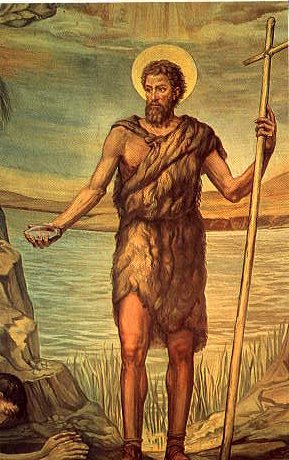
stjohnA few things that jump out to me in this passage.  First, in verse 1, the “good news.” That’s what the word Gospel means.  It is good news.  Jesus is Good News.  The grace of God is good news. When we tell folks about God, we are telling them about good news!  God loves you!  Do we communicate that “good news” like it is actual good news?

In verses 2-3, we see a quotation from the Old Testament prophet Isaiah.  Mark’s Gospel doesn’t have as many Old Testament quotations as Matthew does, but he does quote from the Old Testament a good bit.  Why? Well, a couple of reasons.  First, this shows the Jewish believers that this “new” Christian faith is really the same faith that their ancestors were pointing to.  It is actually what Abraham and Moses and others were hoping and longing for.

And second, it shows us non-Jewish (i.e. Gentile) believers that God was at work for a long time.  We aren’t the first believers in God ever.  God was working all of history towards the coming of Jesus Christ.  And we as Christians, we should not forsake the Old Testament. We should treasure it and read it as well.  It is our story as well. We believe that all the Bible is inspired.  The Old Testament matters to us as well!

In verses 4-8, we see the entrance of John the Baptist.  Can’t you just picture him with this description. And you know what?  He looks different, doesn’t he?  Mark makes it clear to us that he is not like the other religious leaders.  Not in his dress, not in his actions (baptism of repentance) and not in his message – the savior is coming.

John was different. But what was his purpose?  To prepare the way for Jesus.  To get folks ready for Jesus.  To make sure that people knew Jesus and were ready to follow him.

In fact, you and I have the same purpose.  To make Jesus known.  So, we too have a different message and a different purpose.  Just like John, we are called to be different. And we are called to point folks to Jesus.

Today, we share that same mission as John.  To point folks to Jesus.

What questions do you have?  How does this strike you?  Shoot me an email, comment below, or connect with me through social media.

Tomorrow we’ll look at Mark 1:9-15.

If you’d like to receive these thoughts by email, be sure to click here and join my email devotional group!