Day Thirty-Two with Mark: Mark 8:11-12

Today we look some of the doubters Jesus had to deal with in Mark 8:11-12:

The Demand for a Sign
11 The Pharisees came and began to argue with him, asking him for a sign from heaven, to test him. 12 And he sighed deeply in his spirit and said, “Why does this generation ask for a sign? Truly I tell you, no sign will be given to this generation.”

faithI love certain words in scripture. I love how they jump out, how they explode, how the just kind of hang there.  Today for me in this reading that word, or that phrase was “He sighed deeply in His spirit.”

Jesus has literally just feed thousands of people twice.  He has healed Jews and Gentiles across the land.  People are flocking from all over to hear Him preach and to just perhaps touch the fringe of His robe that they may be healed.

Miracles are literally, not figuratively, literally happening everywhere.

And the Pharisees come, asking for a sign.  And He sighed.  Why?

Because what more signs could He produce.  Short of His death and resurrection, which was going to happen, and which they didn’t believe either, what could He do?  So He sighed.  Was is frustration?  Was it exasperation?  Was it just exhaustion?  We don’t know, but we know they He knew they wouldn’t get it. They wouldn’t see, no matter how many signs He did.

Why?  Why wouldn’t they see the signs?  Because they didn’t believe.

When we believe, we see. When we have faith, we see miracles everywhere, every day.  When faith enlivens the eyes, we see the signs of God, of faith, of miracles every day.

When we do not, we do not. When we do not see through faith, we will look, but never see. When we look though, through the eyes of faith, we see them everywhere.

Today, do you see?  God is work. Jesus is doing great things.  It is happening everywhere.

It is.  We can see it.

We just have to look right.  We just have to look through the eyes of faith.

Today, do you see?

Monday we’ll look at Mark 8:14-21.

What questions do you have?  How does this strike you?  Shoot me an email, comment below, or connect with me through social media.

If you’d like to receive these thoughts by email, be sure to click here and join my email devotional group!

Day Thirty-One with Mark: Mark 8:1-10

Today in Mark 8:1-10 we see Jesus feed another multitude.  Earlier in Mark He fed the 5000.  Today, He feeds the 4000:

Feeding the Four Thousand
8 In those days when there was again a great crowd without anything to eat, he called his disciples and said to them, 2 “I have compassion for the crowd, because they have been with me now for three days and have nothing to eat. 3 If I send them away hungry to their homes, they will faint on the way—and some of them have come from a great distance.” 4 His disciples replied, “How can one feed these people with bread here in the desert?” 5 He asked them, “How many loaves do you have?” They said, “Seven.” 6 Then he ordered the crowd to sit down on the ground; and he took the seven loaves, and after giving thanks he broke them and gave them to his disciples to distribute; and they distributed them to the crowd. 7 They had also a few small fish; and after blessing them, he ordered that these too should be distributed. 8 They ate and were filled; and they took up the broken pieces left over, seven baskets full. 9 Now there were about four thousand people. And he sent them away. 10 And immediately he got into the boat with his disciples and went to the district of Dalmanutha.

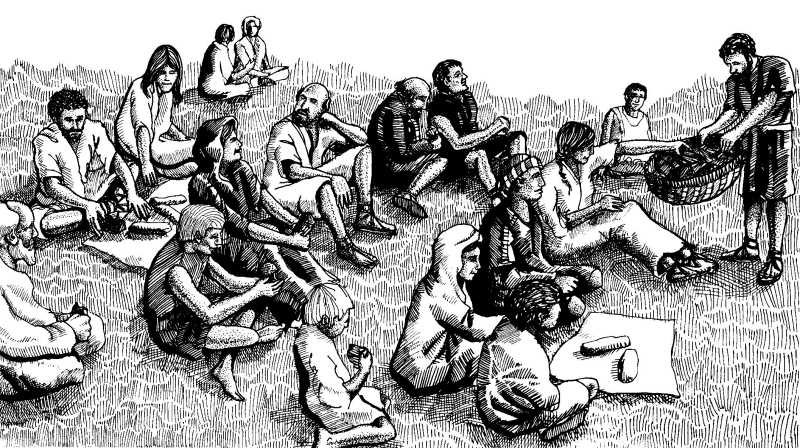
NT Ch15Ok, so why does Jesus feed large crowds twice?  Not to be trite, but the simple answer is that Jesus loved people, and this is at least twice in His ministry when large crowds were with Him, and He knew that if He was to send them away without food they may not make it home.  So, why did Jesus do this twice?  The simple reason is because people needed it twice.

But there is something deeper and bigger going on here, as there is with almost all that happens in the Bible. There are two things that jump out to me in this reading that I think are significant.  First, look at the “faith” of the Disciples.  Remember, they had already seen Jesus feed an even larger crowd before. But when He says that the people must be fed, they say, how can we feed this many people here in the desert?

They’d seen Jesus do it before.  They knew that He could do it, they saw it with their own eyes, the experienced it, they helped.  And yet, they still doubted.

Aren’t we like that?  Don’t we know what God can do?  Haven’t we seen Him do it before?  Aren’t we aware of His power?  Yes.  Yes we are.  And yet, don’t we doubt, as they did?  Don’t we forget, as they did?  They did.  And we do.

On one hand, we need to learn, as they did, to have faith, to not doubt, to remember the faithfulness of God.  Remember how He has been there.  Remember what He has done.  Remember who He is. Remember His faithfulness from generation to generation.

But when we do, we need to show ourselves grace as well. Because we weren’t the first to doubt.  The very ones that walked with Jesus doubted as well.  And He didn’t give up on them. And He won’t give up on us either.

Second, many scholars believe that the first feeding of the multitude (the 5000) was a Jewish crowd, and many think that this crowd, if not mainly Gentile, had many Gentiles within it.  This was on the western side of the Sea of Galilee, which was the more Gentile area.  We cannot say for 100% certain that there were Gentile there, but reading into the context of scripture, it’s a safe assumption.

So, we have seen Him heal Gentiles.  Now we see Him feed Gentiles. We are seeing more and more that Jesus Christ came to redeem the world. All the world.  All that call upon His name.  All

And in a world that is so, so, so very polarized and full of hardening lines, I think it’s important for us to remember that Jesus Christ came for the world.  The entire world. For all who believe.

Today, may we live out that grace with all that we meet.

Friday we’ll look at Mark 8:11-12.

What questions do you have?  How does this strike you?  Shoot me an email, comment below, or connect with me through social media.

If you’d like to receive these thoughts by email, be sure to click here and join my email devotional group!

Day Twenty-Nine with Mark: Mark 7:24-30

Today we are going to look at one of those passages in Scripture that frankly, no one really understands.  Listen to what happens in Mark 7:24-30:

The Syrophoenician Woman’s Faith
24 From there he set out and went away to the region of Tyre. He entered a house and did not want anyone to know he was there. Yet he could not escape notice, 25 but a woman whose little daughter had an unclean spirit immediately heard about him, and she came and bowed down at his feet. 26 Now the woman was a Gentile, of Syrophoenician origin. She begged him to cast the demon out of her daughter. 27 He said to her, “Let the children be fed first, for it is not fair to take the children’s food and throw it to the dogs.” 28 But she answered him, “Sir, even the dogs under the table eat the children’s crumbs.” 29 Then he said to her, “For saying that, you may go—the demon has left your daughter.” 30 So she went home, found the child lying on the bed, and the demon gone.

syrophoenician-woman-3mbOk, there’s a lot happening here.  In Mark’s Gospel, for the first time, we see Jesus heal a Gentile.  We  see Jesus talking with a women (who is a Gentile) which went against the customs of the people by like 1,000%. But these things aren’t out of the ordinary, we see Jesus do things like this quite often.  This is what is different about it.  The language that He uses when talking to the woman.

First He says that the children, which in this case refers to the Jews, must be feed first.  That’s not too unusual in Jesus ministry, several times He sends the Disciples out only the Jewish village.  Jesus is following through with the echoes of Genesis 12 where God tells Abraham that his descendants (the Jewish people) will be a light to the world.  In other words, the call of Abraham was ultimately that the Jewish people would be that light to all the world.  This is God calling out once again to His people.

But what happens next is the part that is hard to understand.  He says to her “it is not fair to take the children’s food and throw it to the dogs.”  In other words is seems to be implying that Jesus is calling Gentiles dogs.  Now some Biblical commentators will say that the word Jesus was using there was more the word for puppy, a play thing, a term of affection. But that really doesn’t seem to be the case.

This is the part that we struggle with, why did Jesus use that term?

Well, let me give you my opinion.  And like I say all the time with my opinion, it and a $1.50 will get you cup of coffee.

I think the first reason He called here that was for her benefit.  Let there be no doubt, He loved her.  He loves the world, He created the world.  So know this.  He loved and valued her.  So, why then did He do it this way?  I think He wanted here to know that she was of great worth to her.  He “tested” her.  And here’s the thing about when God tests us.  The test is never for His benefit, it’s always for ours.  He knows what we will do.  He is not surprised by our choices.  He knows what we will decide.

The test is not for Him.  It’s for us.

Jesus knew she was beloved and His.  She didn’t.  In this conversation, she said out loud that she matters.  And she found within her strength that she didn’t know that she had.  This conversation pushed her to look within herself and say out loud who she was.  She was a child of God.  Jesus knew it.  Now she knew it.

And the second person, or persons, this benefited was the disciples.  They had seen very little interaction with Gentiles.  This would have been one of their first encounters with a Gentile.  And now they see a Gentile WOMAN speaking to Jesus, arguing with Him and now being rewarded by Jesus saying that she has the type of faith that everyone should have.

Could there be any doubt now that Jesus came for the entire world?

This conversation and healing wasn’t just for her benefit, but it was the benefit the Disciples and those that followed Jesus.  He guided the conversation to a place where she had to say out loud what Jesus knew to be true.  She mattered.  She was valuable.  She was His.

He knew that.  In saying it, so does she.  And so did all those that followed.

Tomorrow we’ll look at Mark 7:31-37.

What questions do you have?  How does this strike you?  Shoot me an email, comment below, or connect with me through social media.

If you’d like to receive these thoughts by email, be sure to click here and join my email devotional group!

Day Twenty-Eight with Mark: Mark 7:1-23

Wednesday we looked at the concept of tradition we found in Mark 7:1-23, today we’ll look at some of the specifics of what happens in this text:

The Tradition of the Elders
7 Now when the Pharisees and some of the scribes who had come from Jerusalem gathered around him, 2 they noticed that some of his disciples were eating with defiled hands, that is, without washing them. 3 (For the Pharisees, and all the Jews, do not eat unless they thoroughly wash their hands, thus observing the tradition of the elders; 4 and they do not eat anything from the market unless they wash it; and there are also many other traditions that they observe, the washing of cups, pots, and bronze kettles. 5 So the Pharisees and the scribes asked him, “Why do your disciples not live according to the tradition of the elders, but eat with defiled hands?” 6 He said to them, “Isaiah prophesied rightly about you hypocrites, as it is written,

‘This people honors me with their lips,
but their hearts are far from me;
7 in vain do they worship me,
teaching human precepts as doctrines.’
8 You abandon the commandment of God and hold to human tradition.”

9 Then he said to them, “You have a fine way of rejecting the commandment of God in order to keep your tradition! 10 For Moses said, ‘Honor your father and your mother’; and, ‘Whoever speaks evil of father or mother must surely die.’ 11 But you say that if anyone tells father or mother, ‘Whatever support you might have had from me is Corban’ (that is, an offering to God — 12 then you no longer permit doing anything for a father or mother, 13 thus making void the word of God through your tradition that you have handed on. And you do many things like this.”

14 Then he called the crowd again and said to them, “Listen to me, all of you, and understand: 15 there is nothing outside a person that by going in can defile, but the things that come out are what defile.”

17 When he had left the crowd and entered the house, his disciples asked him about the parable. 18 He said to them, “Then do you also fail to understand? Do you not see that whatever goes into a person from outside cannot defile, 19 since it enters, not the heart but the stomach, and goes out into the sewer?” (Thus he declared all foods clean.) 20 And he said, “It is what comes out of a person that defiles. 21 For it is from within, from the human heart, that evil intentions come: fornication, theft, murder, 22 adultery, avarice, wickedness, deceit, licentiousness, envy, slander, pride, folly. 23 All these evil things come from within, and they defile a person.”

imgresJesus point in all of this is this.  It’s what on the inside that causes the outward action to happen.  Our faith, at its heart, is a matter of the heart.  We are an inside out religion.  What happens in the heart, what happens in our faith that will show itself in our actions.

Here’s the thing, like I like to tell my church, if Jesus has your heart, He will have your actions.  He just will.  If He is Lord of your heart, He will become Lord of your actions.

But you can “do” right, and not “be” right.  And if you are not right, in time, you will stop acting right.  Because our heart always determines our actions.  For us, as Christians, it starts internally.  And it shows itself externally.

In this passage, He is saying that the people are honoring God with their words, but their hearts are far away.  And in time, their words will move as well.  Their words and their actions will follow their heart.

So, the first, and the main question is this.  Where is our heart?  That question truly does determine everything else.  That question answers all the other issues that we will face.

We are an inside out religion.  Never forget that.  Never put the cart before the horse.  If Jesus is Lord of our heart, He will become Lord of every area of our life.

Today, may that be so.

Monday we’ll look at Mark 7:24-30.

What questions do you have?  How does this strike you?  Shoot me an email, comment below, or connect with me through social media.

If you’d like to receive these thoughts by email, be sure to click here and join my email devotional group!

Day Twenty-Seven with Mark: Mark 7:1-23

The next few days we’ll dig a little deeper into Mark 7:1-23:

The Tradition of the Elders
7 Now when the Pharisees and some of the scribes who had come from Jerusalem gathered around him, 2 they noticed that some of his disciples were eating with defiled hands, that is, without washing them. 3 (For the Pharisees, and all the Jews, do not eat unless they thoroughly wash their hands, thus observing the tradition of the elders; 4 and they do not eat anything from the market unless they wash it; and there are also many other traditions that they observe, the washing of cups, pots, and bronze kettles.  5 So the Pharisees and the scribes asked him, “Why do your disciples not live according to the tradition of the elders, but eat with defiled hands?” 6 He said to them, “Isaiah prophesied rightly about you hypocrites, as it is written,

‘This people honors me with their lips,
but their hearts are far from me;
7 in vain do they worship me,
teaching human precepts as doctrines.’
8 You abandon the commandment of God and hold to human tradition.”

9 Then he said to them, “You have a fine way of rejecting the commandment of God in order to keep your tradition! 10 For Moses said, ‘Honor your father and your mother’; and, ‘Whoever speaks evil of father or mother must surely die.’ 11 But you say that if anyone tells father or mother, ‘Whatever support you might have had from me is Corban’ (that is, an offering to God — 12 then you no longer permit doing anything for a father or mother, 13 thus making void the word of God through your tradition that you have handed on. And you do many things like this.”

14 Then he called the crowd again and said to them, “Listen to me, all of you, and understand: 15 there is nothing outside a person that by going in can defile, but the things that come out are what defile.”

17 When he had left the crowd and entered the house, his disciples asked him about the parable. 18 He said to them, “Then do you also fail to understand? Do you not see that whatever goes into a person from outside cannot defile, 19 since it enters, not the heart but the stomach, and goes out into the sewer?” (Thus he declared all foods clean.) 20 And he said, “It is what comes out of a person that defiles. 21 For it is from within, from the human heart, that evil intentions come: fornication, theft, murder, 22 adultery, avarice, wickedness, deceit, licentiousness, envy, slander, pride, folly. 23 All these evil things come from within, and they defile a person.”

traditionWhat I want to do the next two days is today talk a little bit about the notion of “tradition” and then on Friday talk about some of the specifics Jesus is talking about in this passage.

Today we see Jesus talking about the tradition of the elders.  We have talked about this before with the Pharisees but what is happening here is that after the Jews returned from the exile, their failure to keep the covenant was a primary motivation for them.  They were determined not to make the same the same mistakes of the past. So, they set up rules and laws that the people had to follow to ensure that they would not break the law.

These new, non-biblical rules became passed down as the traditions of the elders. They weren’t biblical like the law, but they became codified as that tradition.

So, because of passages like this, we have become very wary of tradition.  Some churches and people would not affirm historic documents like the Apostle’s Creed because they will not affirm “man made” doctrine or traditions like that.  For some believers, the notion of tradition is still something to be aware of.

However, for the tribe that I’m part of, the United Methodist Church, we affirm tradition as one of the ways that God affirms Himself and teaches us. So, how can we (and other) churches put validity into tradition while Jesus clearly condemns it here?

There at two types of tradition.  There is what I call “little t” tradition and what I call “big T” Tradition.  Little t tradition is normally tied to the things that happen that local community or church. They are individual and vary from place to place.  They may be good traditions, they may be bad traditions. But they are local to that place or region or time.

Big T Tradition is the faith handed down to us by our parents and grandparents.  The teachings of Wesley, of Calvin, of Luther, of Lewis, of Aquinas, of Francis.  This is the faith that has been passed down for thousands of years from the Apostles.  The teaching of the Christian church for over 2000 years.

This Tradition, it is very good.  It is not perfect, it is not scripture, it doesn’t carry the same weight or authority as scripture, but it has much to teach us about who God is and what we believe as Christians.

This tradition is very good.

So, when you hear talk about tradition, be clear on what the tradition is.  Is it “little t” or “big T?”  Tradition can teach us so very much.  May we have discerning hearts on this, and all things.

Friday we’ll look at Mark 7:1-23 some more.

What questions do you have?  How does this strike you?  Shoot me an email, comment below, or connect with me through social media.

If you’d like to receive these thoughts by email, be sure to click here and join my email devotional group!

Day Twenty-Six with Mark: Mark 6:45-52

Today in walk together through Mark, we see Jesus perform more healing.  Listen to what happens in Mark 6:53-56:

Healing the Sick in Gennesaret
53 When they had crossed over, they came to land at Gennesaret and moored the boat. 54 When they got out of the boat, people at once recognized him, 55 and rushed about that whole region and began to bring the sick on mats to wherever they heard he was. 56 And wherever he went, into villages or cities or farms, they laid the sick in the marketplaces, and begged him that they might touch even the fringe of his cloak; and all who touched it were healed.

3485297601_b789b3fa39We see Jesus come into town after walking on the water, and we see that so many people come to Him for healing.  They come from all over. They lay upon mats, they, they bring their friends, they want just a touch of Him, just a brush.  People just wanted to touch the fringe of His cloak.  This fringe would have been the knots that would have been tied nad untied as Jesus was praying.  People knew that if they just had that brief encounter with Jesus, it would change things.

And that’s the truth of Scripture.  Jesus changes things.  You cannot touch Jesus, you cannot be touched by Jesus, you cannot encounter Him, and not be changed.

Jesus changes things.

We are tempted to look to willpower to change things.  Or religion to change things.  Or self-awareness to change things.  Or many different things to change things.

But in truth, only one thing will change things.  Jesus.  He changes us.  He changes us others.  The people in this text understood that.  They knew that He would change them.

And today, may we understand it, just the same.  Jesus changes us.  Changes others.  Changes lives.  Changes families.  Changes the world.  Changes churches, communities, everything.

Let’s live in His grace today.  And let’s see what He changes in us.

Tomorrow we’ll look at Mark 7:1-23.

What questions do you have?  How does this strike you?  Shoot me an email, comment below, or connect with me through social media.

If you’d like to receive these thoughts by email, be sure to click here and join my email devotional group!

Day Twenty-Five with Mark: Mark 6:45-52

Near the end chapter 6 of Mark, we see stories that we all know so well, the feeding of the 5000, and now in verses 45-52, we see Jesus walking on water. Listen to what the Word tells us:

Jesus Walks on the Water
45 Immediately he made his disciples get into the boat and go on ahead to the other side, to Bethsaida, while he dismissed the crowd. 46 After saying farewell to them, he went up on the mountain to pray.

47 When evening came, the boat was out on the sea, and he was alone on the land. 48 When he saw that they were straining at the oars against an adverse wind, he came towards them early in the morning, walking on the sea. He intended to pass them by. 49 But when they saw him walking on the sea, they thought it was a ghost and cried out; 50 for they all saw him and were terrified. But immediately he spoke to them and said, “Take heart, it is I; do not be afraid.” 51 Then he got into the boat with them and the wind ceased. And they were utterly astounded, 52 for they did not understand about the loaves, but their hearts were hardened.

We see Jesus send the disciples back across the late to close to where they were staying.  But notice what Jesus does when He sends them off.  The text says that He goes up to the mountain to pray.  I think that’s one thing that we always have to take away from Jesus’ life when we look at it. The important of prayer for His life.  Jesus always, always, always spends time in prayer.

And to me, that’s such a huge thing, because think about this.  Jesus Christ is the very son of God.  He is the second person of the Trinity.  He is part of the Godhead.  He is literally one with God.  Literally.

And yet He takes time to pray to His Father.  He takes time to seek His Father’s face in prayer.  Jesus Christ knows the importance, the value, the purpose of prayer.  And He’s God Himself.

So, if Jesus understands the importance of prayer, shouldn’t we?  If Jesus took time to pray, shouldn’t we?  If this matter to Jesus, shouldn’t it matter to us?  Each time in scripture when I see Jesus understand the importance of prayer, I am reminded about just how important prayer is.  And I have to ask myself, do I pray as I ought?

Prayer mattered to Jesus.  It has to matter to us as well.

Amédée_Varint_-_Christ_marchant_sur_la_merAfter this time of prayer, we see Jesus walking upon the waters to the disciples.  And notice what they feel when they see Him walking out to them?  Fear.  They are afraid.  Because the know that no man can do this.  This is not human, they think that He’s a ghost.  They are terrified.

When they (or we) see Jesus fully in His power, it is a terrifying thing.  He is awe inspiring.  He is other.  He is God.  And that’s one of those things that our mind cannot hold together.  The incarnation.  Jesus is fully God and fully human.  He is Lord and friend.  He is our guide and He is our savior.  And He never leaves us.

Do not fear.  Do not be afraid.  No matter how big the problems you are face, Jesus is bigger.  Trust.

Do not fear.

Tomorrow we’ll look at Mark 6:35-56.

What questions do you have?  How does this strike you?  Shoot me an email, comment below, or connect with me through social media.

If you’d like to receive these thoughts by email, be sure to click here and join my email devotional group!

Day Twenty-Four with Mark: Mark 6:30-44

Today in journey through Mark we look at the feeding of the 5000 in Mark 6:30-44:

Feeding the Five Thousand
30 The apostles gathered around Jesus, and told him all that they had done and taught. 31 He said to them, “Come away to a deserted place all by yourselves and rest a while.” For many were coming and going, and they had no leisure even to eat. 32 And they went away in the boat to a deserted place by themselves. 33 Now many saw them going and recognized them, and they hurried there on foot from all the towns and arrived ahead of them. 34 As he went ashore, he saw a great crowd; and he had compassion for them, because they were like sheep without a shepherd; and he began to teach them many things. 35 When it grew late, his disciples came to him and said, “This is a deserted place, and the hour is now very late; 36 send them away so that they may go into the surrounding country and villages and buy something for themselves to eat.” 37 But he answered them, “You give them something to eat.” They said to him, “Are we to go and buy two hundred denarii[a] worth of bread, and give it to them to eat?” 38 And he said to them, “How many loaves have you? Go and see.” When they had found out, they said, “Five, and two fish.” 39 Then he ordered them to get all the people to sit down in groups on the green grass. 40 So they sat down in groups of hundreds and of fifties. 41 Taking the five loaves and the two fish, he looked up to heaven, and blessed and broke the loaves, and gave them to his disciples to set before the people; and he divided the two fish among them all. 42 And all ate and were filled; 43 and they took up twelve baskets full of broken pieces and of the fish. 44 Those who had eaten the loaves numbered five thousand men.

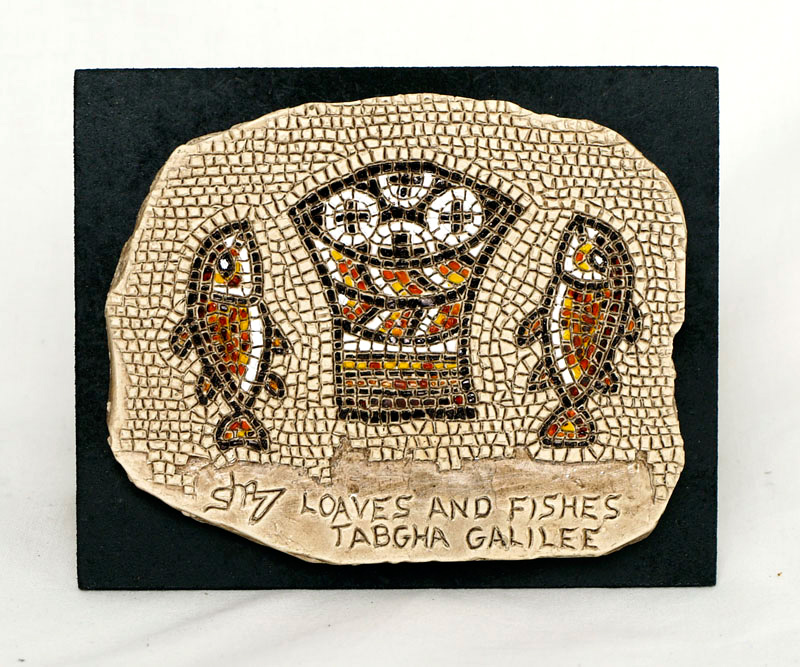
small_mosaic_1Today is one of those stories that we have all heard a million times.  We know about Jesus feeding the 5000.  We’ve heard stories about it, we’ve heard sermons about it, we’ve read it, we know it. So, today, go back and read it, like you’ve never heard it before.  Don’t rush through it, don’t think about how you’ve heard it before.  Go back and read it like it’s the first time.

Ok, what do you notice?  What did you see in this reading that you never really noticed before.  That’s one of the ways to hear God’s voice in scripture; what jumps out to you?  What did you notice that you didn’t notice before?

Let me tell you what I noticed today when I read this passage.

First, in 31, we see Jesus concern for His disciples. They had been working and serving and hadn’t had any time to rest.  That mattered to Jesus.  He tells them, let’s go away.  Let’s get some rest.  Take care of yourself.  It’s ok to focus on your needs.  Not to the exclusion of others as we will see in a moment, but take care of yourself.  Get enough food.  Enough rest.  Enough care.

These bodies, this life, they are gifts from God.  Take care of them.  Jesus noticed they were exhausted.  And the said, let’s go rest.

But then, notice in 34, when people came to them, He didn’t say, nope, we are busy.  How often in our lives do people irritate us when they interrupt our plans?  What did Jesus say and do?  He had compassion.  He had compassion for them.  He and the disciples took time to serve them.  That’s a great reminder to us when things don’t go as we plan them to or desire them to.  Don’t lose sight of the humanity and the need of other people, even when they come at an inconvenient time for you.

Serve them anyway.

And I love what it says in 42.  They ate, and they were filled.  Jesus filled them completely.  He took care of them.  He loved them.  He cared for them.  He made sure they had what they needed.

He does the same for us.  He loves you.  He cares for you.  He meets your needs.

That’s who He is.

Today, what did you notice the reading of this familiar story?

Monday we’ll look at Mark 6:45-52.

What questions do you have?  How does this strike you?  Shoot me an email, comment below, or connect with me through social media.

If you’d like to receive these thoughts by email, be sure to click here and join my email devotional group!

Day Twenty-Three with Mark: Mark 6:14-29

Today in Mark we look at the death of John the Baptist, as found in Mark 6:14-29:

The Death of John the Baptist
14 King Herod heard of it, for Jesus’ name had become known. Some were saying, “John the baptizer has been raised from the dead; and for this reason these powers are at work in him.” 15 But others said, “It is Elijah.” And others said, “It is a prophet, like one of the prophets of old.” 16 But when Herod heard of it, he said, “John, whom I beheaded, has been raised.”

17 For Herod himself had sent men who arrested John, bound him, and put him in prison on account of Herodias, his brother Philip’s wife, because Herod had married her. 18 For John had been telling Herod, “It is not lawful for you to have your brother’s wife.” 19 And Herodias had a grudge against him, and wanted to kill him. But she could not, 20 for Herod feared John, knowing that he was a righteous and holy man, and he protected him. When he heard him, he was greatly perplexed; and yet he liked to listen to him. 21 But an opportunity came when Herod on his birthday gave a banquet for his courtiers and officers and for the leaders of Galilee. 22 When his daughter Herodias came in and danced, she pleased Herod and his guests; and the king said to the girl, “Ask me for whatever you wish, and I will give it.” 23 And he solemnly swore to her, “Whatever you ask me, I will give you, even half of my kingdom.” 24 She went out and said to her mother, “What should I ask for?” She replied, “The head of John the baptizer.” 25 Immediately she rushed back to the king and requested, “I want you to give me at once the head of John the Baptist on a platter.” 26 The king was deeply grieved; yet out of regard for his oaths and for the guests, he did not want to refuse her. 27 Immediately the king sent a soldier of the guard with orders to bring John’s head. He went and beheaded him in the prison, 28 brought his head on a platter, and gave it to the girl. Then the girl gave it to her mother. 29 When his disciples heard about it, they came and took his body, and laid it in a tomb.

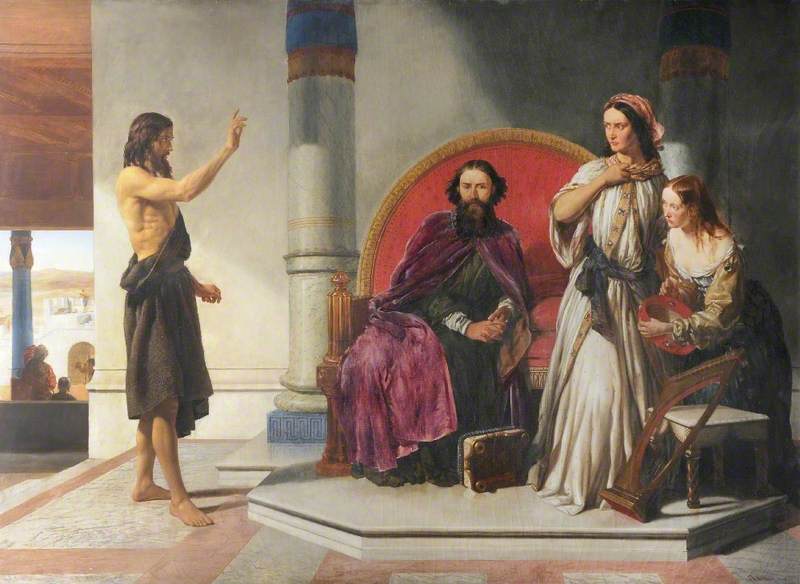
John the Baptist is Jesus’ family and friend.  While many folks questioned and doubted who Jesus was, John believed.  Now we see John at times, under the stress of the moment, doubt as well, we see though, that John knew who Jesus was.  Jesus loved Him.  And John loved and followed Jesus.

And we see in this passage that John is murdered by the king.

I think that there are several things that we can learn from this passage today.  First, we see that just because we faithful, it doesn’t mean that we wound face troubles.  John was faithful.  John did what was right.  John stood for Jesus, John stood up against what was wrong.

And because of that John was struck down by the king.  Sometimes, doing what is right doesn’t mean that you won’t face troubles, in fact, it’s the other way.  Doing what’s right may increase your troubles.

So today, if you face opposition or trouble, don’t get down.  Don’t get discouraged.  It means you are being faithful.  In this world we will face troubles, but take heart.  Jesus has overcome this world.  Don’t worry.  Trust!

And then we can learn a lot from looking at Herod.  Two things jump out to me about him looking at the text.  First, he “knew” what was right.  Notice he like to hear John preach.  He knew he was a prophet.  He knew his words word true.  He knew that was John was saying was right.  He knew it.  But yet he didn’t want to do anything about it.  He didn’t want to change.

It isn’t enough that we know what is true.  We have to follow what is true.  Herod knew what was true.  He just didn’t want to follow it.

And the second thing I notice is the danger of pride.  He didn’t want to behead John.  It grieved him.  But yet, to not do that would have been embarrassing.  It would have harmed his pride.  So, he had to choose between doing what was right, or his pride.

And he chose his pride.

Pride is a dangerous thing.  Proverbs tells us that the pride goes before the fall.  Because of Herod’s pride, he choose wrong and did great harm.  

May we not make the same mistake today!

Friday we’ll look at Mark 6:30-44.

What questions do you have?  How does this strike you?  Shoot me an email, comment below, or connect with me through social media.

If you’d like to receive these thoughts by email, be sure to click here and join my email devotional group!

Day Twenty-two with Mark: Mark 6:6-13

Today in our daily journey together through Mark, we see Jesus sending out the twelve to do ministry, as found in Mark 6:6-13:

The Mission of the Twelve
Then he went about among the villages teaching. 7 He called the twelve and began to send them out two by two, and gave them authority over the unclean spirits. 8 He ordered them to take nothing for their journey except a staff; no bread, no bag, no money in their belts; 9 but to wear sandals and not to put on two tunics. 10 He said to them, “Wherever you enter a house, stay there until you leave the place. 11 If any place will not welcome you and they refuse to hear you, as you leave, shake off the dust that is on your feet as a testimony against them.” 12 So they went out and proclaimed that all should repent. 13 They cast out many demons, and anointed with oil many who were sick and cured them.

When we look at this passage we see the twelve go out and do a similar ministry to that which Jesus had been doing. There is teaching.  There is authority.  There is traveling from village to village, sharing the news of the kingdom of God.  They travel to all villages, with this good news, bringing life, hope, freedom, wherever it is that they go.

11705277_1025230754176400_7895478622006202186_nBut there are a couple of things that stand out to me about this passage.  First, notice how Jesus sends them out.  Two by two.  No one is sent out alone.  As Christians, we are not meant to walk this path alone.  We are not meant to do ministry alone.  We are not meant to live out the good news of Jesus Christ by ourselves.

Faith is hard when you are in community with others.  It is nearly impossible by yourself.  There are going to be times when you want to give up.  When you are overwhelmed.  When you think that you can’t do it.  And you know what?  By yourself, you can’t.

That’s why Jesus sends them out two by two.  They needed each other for the ministry.  So do we.

Second, notice what message they proclaimed.  All should repent.  Not just some.  Not just “bad” people.  Not just “them.”  But all should repent.  Me.  You.  Everyone.  We should all turn away from our sins, and we should all turn to Jesus.  Repentance is not just something that those that don’t know Jesus do, it’s something that we all do.

We all, no matter where we are, need to turn away from things that are harmful, and we all, no matter where we are, need to turn to Jesus.

That’s repentance.  And that’s why all are called to it.

Because we all need it.

Tomorrow we’ll look at Mark 6:14-29.

What questions do you have?  How does this strike you?  Shoot me an email, comment below, or connect with me through social media.

If you’d like to receive these thoughts by email, be sure to click here and join my email devotional group!