
When my Mama passed away, nearly two years ago, I went through the traditional rituals we do here in the South. Going home, having the funeral, meal at the church, everything, all of us have done, or will do. There are other parts of the ritual, and one of my favorites is looking through old pictures. As anyone who knows me knows, I’m very photogenic (he says tongue firmly planted in cheek).
I love seeing old pictures. What’s better than that? A couple of pictures I found while looking through her photos raised more questions than they answered. The reason for that is that they come from a time in her life I know so little about. I know all about Pike County and Bogue Chitto and Johnston Chapel UMC and Montgomery Baptist and all that is around there. I know those stories and those people.
What I don’t know about is Ecuador.
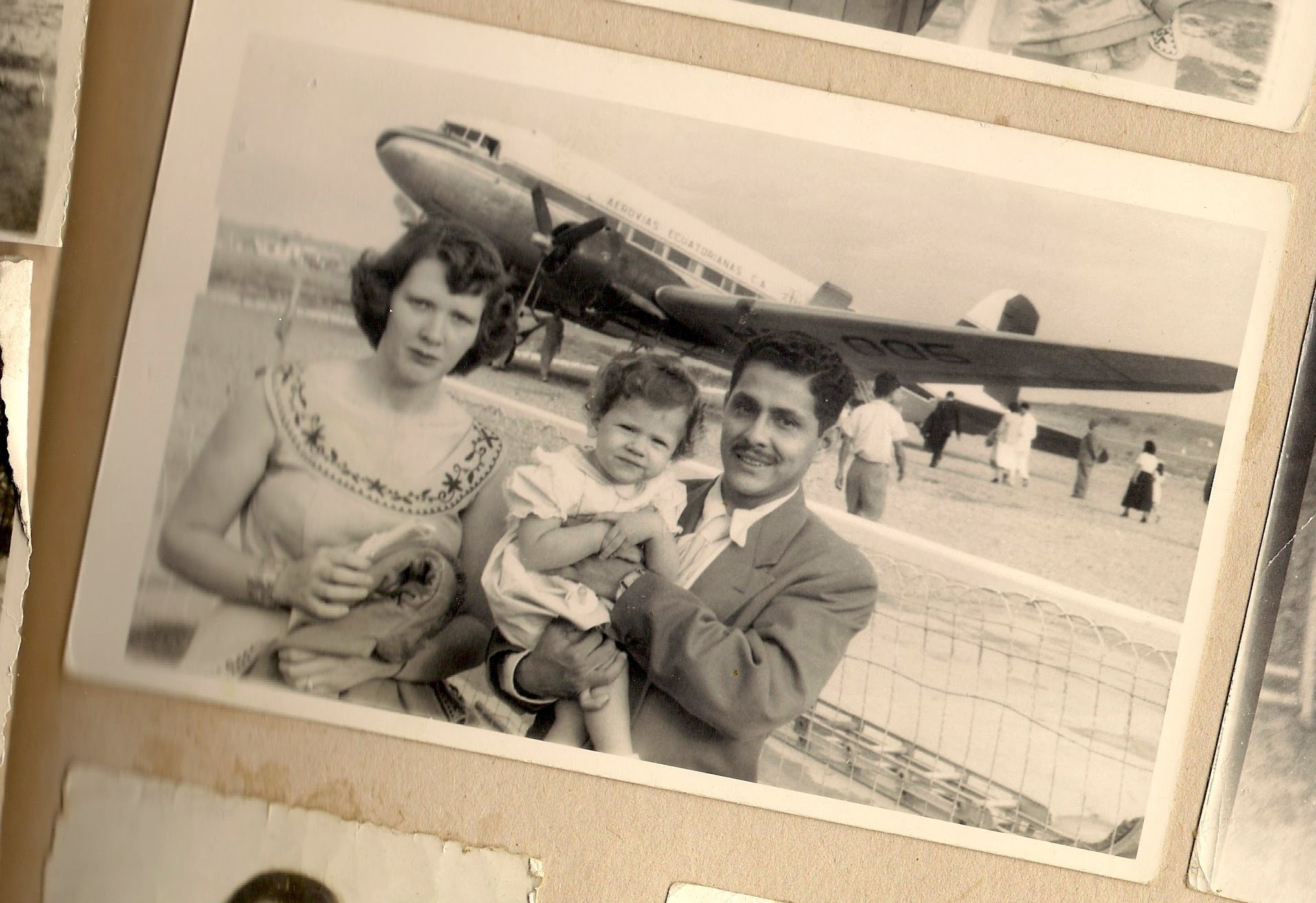
The pictures I found are of my Mama (Maxine Stoddard) as a young mother, with her daughter, Sarah (my birthmother), and her husband, Carol Leon, after disembarking in Ecuador. They are young and ready to take on the world. This is the youngest picture I’ve ever seen of my Mama Sarah; she was just a toddler. She was born in Guayaquil, so I’m guessing the picture is one of Maxine and Carol returning from Ecuador after visiting the United States.
But, I’m unsure. That’s one of the questions I have that I would have loved to have asked my mama (Maxine) before she passed. I have so many.
When was this picture taken? What was the story behind it?
What was it like to live in Ecuador in the 1950s?
How did you meet Carol? How do you fall in love? Where do you get married?
How did you find the courage to leave him?
How did you find the courage to move back to Mississippi in the 1960s with two children of mixed race? How did you find the strength to work and support them?
Questions matter.
I have so many questions, questions that I know that I’ll never have an answer to. But I still wonder about them.
I have had many great teachers in my life, and one of the lessons I have learned is that often the question is more important than the answer. If you ask the right questions, you will get the right answer. I heard Skye Jethani say on a podcast, “Curiosity is a side effect of confidence.” I keep that quote on a post-it note on my wall. I want to be curious. I want to learn. I want to ask the right questions.
So, when I look at life and situations, I try to ask questions first. Gather information and data, then make a decision based on what is known.
Questions matter.
I wonder what questions my Mama Sarah would ask today if she were still living?
How would she feel about the way things are going in the nation?
Would she be afraid? Angry? What would she think?
How would she be proud of the way that I live and lead? Would she be proud of the way my church carries itself?
She sacrificed her very life so that I would not be raised in a dangerous situation. Many of you know my story. I think about that quite often. That causes me to ask questions about myself.
Am I leading well?
Am I sowing peace and unity?
Am I calling people to their better angels? Am I calling people out of their worst impulses and to loving others?
Am I calling people to love, even sacrificially?
Am I trying with everything I am to be the hands and feet of Jesus?
Am I calling people to courage?
Questions matter.
I think we approach too many situations with answers already formed, and in doing so, I believe we do not leave room for the Holy Spirit to convict, challenge, empower, or push us to where God needs us to be.
Jesus asked many questions in Scripture.
If you greet only your brothers, what are you doing more than others? (Matthew 5:47)
Suppose one of you has a hundred sheep and loses one of them. Does he not leave the ninety-nine in the open country and go after the lost sheep until he finds it? (Luke 15:4)
Or suppose a woman has ten silver coins and loses one. Does she not light a lamp, sweep the house, and search carefully until she finds it? (Luke 15:8)
Where are they? Has no one condemned you? (John 8:10)
These are just a few, but so often in Scripture, Jesus pushed His disciples, His followers, and even those who opposed him to think. I think that’s a good lesson for us. To ask questions. To think. To clarify. And then, once we have asked the question, and perhaps know our answer, live that out.
One of my favorite moments in scripture is when someone asked Jesus a question. In Matthew 22:36-40, we read:
“Teacher, which is the greatest commandment in the Law?”
Jesus replied: “‘Love the Lord your God with all your heart and with all your soul and with all your mind.’ This is the first and greatest commandment. And the second is like it: ‘Love your neighbor as yourself.’ All the Law and the Prophets hang on these two commandments.”
I think in this moment, we have an answer to some important questions. How shall I live? What matters most? Loving God and Neighbor. There is THE answer. And those answers form our next question.
Am I living that out? Am I truly loving God and Neighbor? Someone asked Jesus who their neighbor was, and he gave a surprising answer. It was the person they would probably have loved the least. A Samaritan. Someone beneath them, a heretic, someone they didn’t want to associate with. That was the model of the neighbor and of whom they were called to love.
So, the question we can ask ourselves is, are we loving the “Samaritans” in our lives?
The Samaritan who is a Democrat?
The Samaritan who is a Republican?
The Samaritan who is an immigrant?
The Samaritan who supports ICE?
And these are the hard questions. And I don’t want to do the “both sides” thing that plagues us so much today. There is right, there is wrong. There is good, and there is evil. But what do we do when we see others doing things that are illegal or immoral? We are called to value life and to see the sacred worth in all people, regardless of their label or classification. So when we see individuals or systems violating our ethics and understandings, are we free to think of them, or do with them as we choose? Are we free to view those who support these actions as fair game for whatever happens? Are we free to throw off their humanity because we hold them to be, or have been told that they are, not fully human?
We cannot, and we must not.
Each of these Samaritans is an image bearer. It is easy to forget that. It is easy in the heat of the moment to throw off restraint. To see these Samaritans as somehow “other.” Different from me. Beneath me. If they are wrong, have acted in ways we disagree with, or have acted illegally or in ways we find morally repulsive, it can make them “other” than they are. We can make them not fully human. And if they are not fully human, then they don’t matter. And if they don’t matter, then it doesn’t matter what happens to them.
That is a dangerous line of thinking, for walking that path turns us into the very thing we claim to despise. In throwing off their humanity, we lose our humanity. We cannot fight moral battles by immoral means. As the great theologian Eddie Vedder once sang:
If you hate something, don’t you do it too (too)
Another question was asked of Jesus by Nicodemus in John 3. Talking about being part of the spirit, he asks, “How can this be?” Jesus tells him about heavenly things and then says:
For God so loved the world that he gave his one and only Son, that whoever believes in him shall not perish but have eternal life.
Whosever. Anyone. All. Everybody. Whosoever.
So, maybe this is the final question for us to consider. Do we really believe that? Do we really believe in whosoever? Do we really believe in the overwhelming, all-consuming, all-including, radical love of God?
Do we believe that?
And if we do, then we must ask the next question.
Does it affect the way I live?
Friends, that’s the question. That’s the question that matters. Does it affect the way that I live? If we really believe that Jesus loves everyone, from my Mama Sarah, to you, to me, to the Samaritans in our lives, if we really believe that.
Does it affect the way we live?
That’s the question.
 RevAndy.org