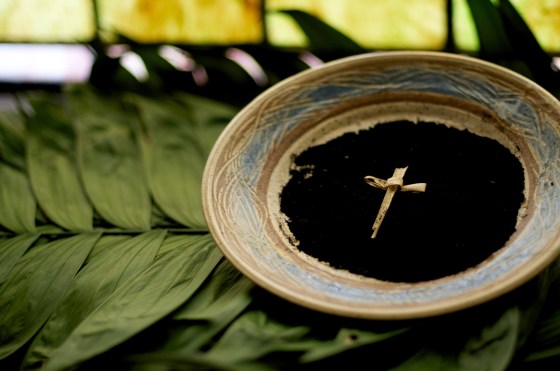
What is Ash Wednesday?

Ash-WednesdayToday is Ash Wednesday.  But what is Ash Wednesday all about?  Why do we do it?  Why is this something that we should focus on?  What is the point?

Ash Wednesday is the first day in the Forty Day season known as Lent.  These forty days (excluding Sunday – I’ll explain why in a bit) are a time for us to remember all that Jesus did for us.  It’s a time for us to remember the depth of all that Jesus went through for us.  His passion.  His suffering.  His death and upon the cross.

And to prepare ourselves for what is to come on Easter.

In the life of the early church, Lent was a season of preparation for those that would be joining the church on Easter.  It was a time of fasting and prayer as these new converts to the faith were making sure that they were truly ready to make their vows to publically become a Christian.  They were preparing to enter a world where being a Christian was something that could cost you your life.  The church wanted to make sure that these new believers knew just what that meant.

So they fasted and prayed for forty days, to prepare.  To make sure. To be ready.  Many churches (our’s at St. Matthew’s is one of them) continues that tradition of individuals joining after Easter, many of those within our Confirmation Class will join our church on the Sunday after Easter.

But why ashes?  Why Ash Wednesday?  Throughout the Bible, ashes are seen as a sign of repentance.  Individuals would put on “sackcloth and ashes” to show public signs of repentance.  You may remember Job sitting in the ashes, after all that happened to him.  To mark yourself in some way with ashes to remember the truth of our lives, ashes to ashes, dust to dust.

Ashes remind us our humanity and our frailty.

So as we start Lent, we begin with ashes.

I said earlier that Sundays are not included within Lent.  Why is that?  Every Sunday is a “little Easter.” Every Sunday we gather together to celebrate the resurrection of Jesus.  So, how can we fast while we celebrate?  Sundays as always splashes of grace within our lives.

During Lent, as a sign of repentance, many of us will give up or fast from something.  It may be a meal, a type of food, an activity.  Something.  What I tell my children is just to make sure that it’s something you like, so you’ll miss it.  And when you miss it, you turn to pray.

That’s the point of fasting, in all of its forms, to drive us to pray and to help us better hear and understand God’s voice.  Fasting helps us listen better, it clears away the clutter. For me, it always helps me pray.

Some, instead of giving up something, will “pick up” something.  Just as Simon of Cyrene picked up the cross to help Jesus, they will pick up, or start something that will help them grow closer to Jesus.  Maybe it’s a spiritual discipline.  Maybe it’s an act of kindness.  It could be any thing that draws us closer to Jesus.

And that’s really the point of Ash Wednesday and of Lent.  It reminds us of our brokenness it reminds us of our frailty and reminds of our need for Jesus.  Luke 14: 9-14 explains this heart quite well:

9 He also told this parable to some who trusted in themselves that they were righteous and regarded others with contempt: 10 ‘Two men went up to the temple to pray, one a Pharisee and the other a tax collector. 11 The Pharisee, standing by himself, was praying thus, “God, I thank you that I am not like other people: thieves, rogues, adulterers, or even like this tax collector. 12 I fast twice a week; I give a tenth of all my income.” 13 But the tax collector, standing far off, would not even look up to heaven, but was beating his breast and saying, “God, be merciful to me, a sinner!” 14 I tell you, this man went down to his home justified rather than the other; for all who exalt themselves will be humbled, but all who humble themselves will be exalted.’

When we humble ourselves, when we repent, when we realize our great need for Jesus, you know what?  We find life.

Today on Ash Wednesday and in this season of Lent, may we find life.  May we find His grace.

If you are in the Madison County area, we’d love to have you join us tonight at St. Matthew’s for our Ash Wednesday service tonight.  We’ll have a meal at 5 p.m. and service at 6 p.m.  If you are unable to make our service and would like to receive ashes, come by the church anytime today and they will be available.

If you’d like to receive these thoughts by email, be sure to click here and join my email devotional group!
What Really Matters

Today in Phillippians 3: 4-11, we see Paul talk about what really matters:

4even though I, too, have reason for confidence in the flesh.  If anyone else has reason to be confident in the flesh, I have more: 5circumcised on the eighth day, a member of the people of Israel, of the tribe of Benjamin, a Hebrew born of Hebrews; as to the law, a Pharisee; 6as to zeal, a persecutor of the church; as to righteousness under the law, blameless.7 Yet whatever gains I had, these I have come to regard as loss because of Christ. 8More than that, I regard everything as loss because of the surpassing value of knowing Christ Jesus my Lord. For his sake I have suffered the loss of all things, and I regard them as rubbish, in order that I may gain Christ 9and be found in him, not having a righteousness of my own that comes from the law, but one that comes through faith in Christ, the righteousness from God based on faith. 10I want to know Christ and the power of his resurrection and the sharing of his sufferings by becoming like him in his death, 11if somehow I may attain the resurrection from the dead.

Cross_in_sunsetPaul in this part of Phillippians is talking about how he (and we) have to trust more in the grace of Jesus than we should in our own works.  He is talking to a group of Christians that are tempted to rely more upon their works and the law than they are on Jesus.

So, Paul lists off all the stuff that he has done.  Stuff, that if you could earn your salvation by what you have done, would surely earn him a place in eternity.  Look at what he has done.  He was as righteous in the law.  He had done all the “right” things.  Paul was about as holy as one could be by the law.

And look at what he says – he considers that all rubbish when compared to knowing Jesus.  He has found in Jesus a righteousness that he could have never found through the law.  He discovered a salvation that doesn’t come from one’s works but comes only through the gift of God’s grace.

He wants to know Jesus.  To know His life.  His death.  And His resurrection.

Paul found this.  He found what really matters wasn’t what he had done.  What really mattered was what Jesus had done.  When compared to the goodness of God, the grace of God, the power of God, the life of God, the stuff of earth just can’t compare.

Paul learned grace.  And here’s what’s cool about grace, especially in the world we live in.  In this world of pressure and work and stress and results and performance reviews.  Grace is not about you.  It’s about Him.  And we can rest in grace.

Rest.  In grace.

Rest.  In Jesus.

Rest.  In His power.

You are loved.  Not because of anything you’ve ever done.  But because of all that He has done.  Paul considered everything rubbish compared to knowing Jesus.  He wasn’t saying that was bad.  He was saying that Jesus was better.

Paul found what really matters.

If you’d like to receive these thoughts by email, be sure to click here and join my email devotional group!

Work Out Your Salvation?

We are going to, for the next few days, reflect upon one of daily lectionary readings that are used by so many as part of what’s called the Morning Office.  You can find a link to these readings here.

Today in Philippians 2:12-13, we read these words:

12 Therefore, my beloved, just as you have always obeyed me, not only in my presence, but much more now in my absence, work out your own salvation with fear and trembling; 13for it is God who is at work in you, enabling you both to will and to work for his good pleasure.

weightliftingThese two verses here share with us some of the most important details of being a Christian. The first of these details is when we come to saving faith in Jesus Christ, that is not the end of our journey of faith.  But in fact, it’s just the beginning.
Paul here tells us to work out our salvation with much fear and trembling.  That I think is important, but also dangerous and scary if we don’t read the entire verse.  It’s important, because God desires that we be faithful.  God desires us to grow.  To learn.  To do our part.  Our “part” doesn’t save us, only God saves us.  But when we are faithful, when we do things that allow us to grow, it really does please God.  We work out our salvation as we are faithful.

Now here’s why we have to read the entire part of this verse.  As Paul says in verse 13, but know this.  It’s God is who is at work in us.  We aren’t “doing” it.  God is doing it for us and through us.  It is God that is the one that is at work.

For all that we do, remember, it’s God’s grace that enables us to do it.  It’s God’s grace that empowers us.  It’s God’s grace that makes it all possible.

So yes, we do our part, we are at work. But know, just as oxygen and food give us the ability to do the things we are supposed to do each day, that’s how God’s grace is.  His grace, it gives us the ability to be faithful.

We can’t do it, we can’t do anything, without God’s grace.

So, today, may we be faithful.  And may we remember that it is only through God’s grace that makes us faithful.

If you’d like to receive these thoughts by email, be sure to click here and join my email devotional group!

Our Last Day with Mark: Mark 16:9-20

Today we are finishing up our time with Mark.  You can go through and read all our reflections on Mark here on my blog, you can group them under the category Mark below and catch up.  Friday we’ll do a reading from our Daily Readings, and I’ll be thinking about what is next.

The Longer Ending of Mark

Jesus Appears to Mary Magdalene
9 [[Now after he rose early on the first day of the week, he appeared first to Mary Magdalene, from whom he had cast out seven demons. 10 She went out and told those who had been with him, while they were mourning and weeping. 11 But when they heard that he was alive and had been seen by her, they would not believe it.

Jesus Appears to Two Disciples
12 After this he appeared in another form to two of them, as they were walking into the country. 13 And they went back and told the rest, but they did not believe them.

Jesus Commissions the Disciples
14 Later he appeared to the eleven themselves as they were sitting at the table; and he upbraided them for their lack of faith and stubbornness, because they had not believed those who saw him after he had risen. 15 And he said to them, “Go into all the world and proclaim the good news to the whole creation. 16 The one who believes and is baptized will be saved; but the one who does not believe will be condemned. 17 And these signs will accompany those who believe: by using my name they will cast out demons; they will speak in new tongues; 18 they will pick up snakes in their hands, and if they drink any deadly thing, it will not hurt them; they will lay their hands on the sick, and they will recover.”

The Ascension of Jesus
19 So then the Lord Jesus, after he had spoken to them, was taken up into heaven and sat down at the right hand of God. 20 And they went out and proclaimed the good news everywhere, while the Lord worked with them and confirmed the message by the signs that accompanied it.]]

the-gospel-of-mark1We talked Monday about why Chapter 16 is made it like it is, with the notations of the different manuscripts.  Today, we see these last few verses in Mark are in four different sections, and only one of them really makes us go, huh?

The first section – 9-10, Jesus appears to Mary, just as it happens in other Gospels. The first person to see Jesus after the resurrection was Mary. She was dedicated to Him, she loved Him, and she came to help prepare His body for final burial.  And she was the first one to proclaim the resurrection.  She was the first of many throughout the ages to tell others that Jesus is alive.  She was the first to share that Good News.  But notice, they didn’t believe her.

Second, 12-13, what sounds very similar to the walk to Emmaus in Luke.  In Luke’s Gospel we see a fuller picture of what happened here, two followers were walking to the village of Emmaus when Jesus appeared to them, explained how all the scriptures point to Him, to His death, and resurrection, but they didn’t recognize Him.  It wasn’t until they arrived at the village, and they broke bread together that they realized it was Jesus.  So, they go and tell others, but notice, just like in the section before, they didn’t believe them.

Third, 14-18, Jesus appears to the Disciples.  Ok, here there are some things that make us go, wait, what?  We see a similar end to what we see in Matthew, with Jesus sending them out with the great commission. But we see something unique to Mark.  We see that they will have signs of great power, they will be able to drink poison, handle snakes, speak in tongues, other such things.  What are we to do this?

First, it is in the Bible.  One of my professors in seminary always told us that we can’t just ignore passages of scripture that confuse us or that we don’t like.  They are in the Bible.  This ending of Mark is what is found most common in the manuscripts that the Bible comes from (I unpack a lot this Monday), but know, it is the Bible.  So, I believe that those that follow Jesus, we can face amazing things, things that would kill others, and survive.  I believe we have power that the world does not possess.  Now notice, it didn’t say that we should necessarily go looking for trouble or for these things. But if they come, we will have more power than we think is even possible.

So, I’m not going to go out handling snakes. But, I do believe in miracles.  And I do believe that as Christians, we are filled with the Holy Spirit, and we may not understand all that God does through us, He can and does do amazing things through us.  We are filled with the very Spirit that raised Christ from the dead.  Trust.  Hope.  Beleive.

Don’t be like those initial disciples.  Have faith.

Fouth, 19-20, the ascension.  We see Jesus ascend to heaven, where He sits at God’s right hand, praying for us, encouraging us, interceding for us.  Remember, you always have someone on your side, someone pulling for you, someone that loves you, someone that cares for you, someone there for you.  Jesus.  He is at the right hand of the Father.  On your team.  Never forget that.

What questions do you have?  How does this strike you?  Shoot me an email, comment below, or connect with me through social media.

If you’d like to receive these thoughts by email, be sure to click here and join my email devotional group!

Day Sixty-Two with Mark: Mark 16:1-8

Yesterday we looked at the reason behind the way the way that the Gospel of Mark ends.  Today we look at Mark 16:1-8:

When the sabbath was over, Mary Magdalene, and Mary the mother of James, and Salome bought spices, so that they might go and anoint him. 2 And very early on the first day of the week, when the sun had risen, they went to the tomb. 3 They had been saying to one another, “Who will roll away the stone for us from the entrance to the tomb?” 4 When they looked up, they saw that the stone, which was very large, had already been rolled back. 5 As they entered the tomb, they saw a young man, dressed in a white robe, sitting on the right side; and they were alarmed. 6 But he said to them, “Do not be alarmed; you are looking for Jesus of Nazareth, who was crucified. He has been raised; he is not here. Look, there is the place they laid him. 7 But go, tell his disciples and Peter that he is going ahead of you to Galilee; there you will see him, just as he told you.” 8 So they went out and fled from the tomb, for terror and amazement had seized them; and they said nothing to anyone, for they were afraid.

The Shorter Ending of Mark

[[And all that had been commanded them they told briefly to those around Peter. And afterward Jesus himself sent out through them, from east to west, the sacred and imperishable proclamation of eternal salvation.]]

450165977_e5ed7a3617One of the things that we see when the women encounter the resurrection is fear.  They are afraid. We see it illustrated in other Gospels, they think the body has been stolen or something awful has happened.
Jesus had told them that He would be raised, by they really didn’t get it. They really didn’t understand it.  They (may) have known intellectually, but they really didn’t get it emotionally.  They struggled to understand it.

For the Jewish mind, death was THE result of the fall.  It is what happened because of the fall.  The entire Levitical purity system was in many ways about removing the curse of death.  If you touched anything dead, you were unclean.  Think about the parable of the Good Samaritan.  The reason the priest and Levite passed by is because the man looked death.  The law would not have allowed them to touch him; they would not have been able to do their religious duties.

The high priest must have been born on a house or place that was made of bedrock.  Bedrock is pure rock, there is no dirt or soil beneath it, meaning that there was no way there could have been any bones beneath it, meaning that there was no way they could have been born on top of impurity.

(By the way, thinking along those lines, think about where Jesus was born.  Most likely in a cave.  Pure bedrock.)

This is why they really couldn’t grasp it.  You didn’t overcome death.  Death was the result of this life.  Death is the curse.  Death is the result of the fall, death is the result of sin. We all die. All of us.  Death wins.

Until this moment.  Death has been overcome.  Death has been defeated.  Death has been destroyed.  Sin, death, and the grave are no more. They are vanquished. They are gone.  They are no more.

Jesus defeated death.  Forever.

We sort of get that and understand it.  Sort of. Even we struggle to understand that. Even we are afraid of death like they are.  But we know that Jesus has overcome.

The didn’t really get it until they saw Him and understood.

Today, sin, death, and the grave are defeated.  They hold no power over you. They are no more.  Do not be afraid. Do not worry. Do not fear.  They are forever gone and destroyed.

Jesus has defeated them.

Do not fear.

Tomorrow we’ll finish up Mark by looking at Mark 16:9-20.

What questions do you have?  How does this strike you?  Shoot me an email, comment below, or connect with me through social media.

If you’d like to receive these thoughts by email, be sure to click here and join my email devotional group!

Day Sixty-Two with Mark: The End of Mark 16

Today we look at the end of Mark’s Gospel.  We’ll start with Mark 16:1-8, so read it, and then let’s talk:

When the sabbath was over, Mary Magdalene, and Mary the mother of James, and Salome bought spices, so that they might go and anoint him. 2 And very early on the first day of the week, when the sun had risen, they went to the tomb. 3 They had been saying to one another, “Who will roll away the stone for us from the entrance to the tomb?” 4 When they looked up, they saw that the stone, which was very large, had already been rolled back. 5 As they entered the tomb, they saw a young man, dressed in a white robe, sitting on the right side; and they were alarmed. 6 But he said to them, “Do not be alarmed; you are looking for Jesus of Nazareth, who was crucified. He has been raised; he is not here. Look, there is the place they laid him. 7 But go, tell his disciples and Peter that he is going ahead of you to Galilee; there you will see him, just as he told you.” 8 So they went out and fled from the tomb, for terror and amazement had seized them; and they said nothing to anyone, for they were afraid.

The Shorter Ending of Mark

[[And all that had been commanded them they told briefly to those around Peter. And afterward Jesus himself sent out through them, from east to west, the sacred and imperishable proclamation of eternal salvation.]]

holy_bibleOk, before we get to what actually happens, let’s look at what we see right at the end of verse 8, what’s call the “Shorter Ending of Mark.”  If you have what is called a “modern” version of the Bible, that’d be the NKJV, NIV, NLT, NRSV, ESV, NAB, NASB, any of these modern translations, they will have that, along with a not such as this – “Some of the most ancient authorities bring the book to a close at the end of verse 8. One authority concludes the book with the shorter ending; others include the shorter ending and then continue with verses 9–20. In most authorities verses 9–20 follow immediately after verse 8, though in some of these authorities the passage is marked as being doubtful.”

What does all this mean?  There are two terms in regards to Biblical translation.  One is “autograph” and one is “manuscript.”  The autograph is the original document.  This would be the actual letter that Paul wrote to the Roman church or the actual Gospel that Mark wrote.  The actual first documents.  A manuscript would be a copy of the original document.

We don’t have any of the original documents.  We do, however, have literally thousands of manuscripts. We have more manuscripts of the books of the Bible than we do any other ancient work.  We have more manuscripts than we do any other text, anything from that time period.

Within that, the fact that there are so many manuscripts there, that gives so much added authority and trustworthiness to the Bible.  When you understand the sheer number of documents that are available, it gives more weight to the Bible.

There’s no way it’s just “made up.”  It was there, and believers from the earliest days of faith understood how important it was to their faith.  Understood it’s authority, and understood it’s trustworthiness.

Through the years, the more I have come to know and understand about how we got the Bible, the more I trust it.

So what is happening here in Mark is this.  All of the ancient manuscripts, they have that first part of verse 8.  Some have that “shorter ending” of verse 8.  And some have a “longer ending” that is in verses 9-20. What does this all mean?

I take all that we have in Mark 16: 1-20 as authoritative, because that is the tradition of the church.  That is the church for the longest has regarded as authoritative.  It is what we have regarded as the whole of the book.  I do think it is important through for everyone to be able to understand how God put the bible together that different manuscripts differ on how Mark ends.  Verse 9-20 is the most common ending, the one that most have, but there are some that end after verse 8.

Why is that?

Great question.  Come back tomorrow and we’ll talk about it.

Tomorrow, we’ll spend some more time talking about the text we just read and then we’ll finish up Mark on Wednesday.

What questions do you have?  How does this strike you?  Shoot me an email, comment below, or connect with me through social media.

If you’d like to receive these thoughts by email, be sure to click here and join my email devotional group!